

































Saturday August 15th, 2026, 5:00 PM – House of Hard Bop.
In the previous broadcast*), two pieces from Miles Davis’ album Kind of Blue were played. In this hour, the remaining three titles. A year after the recording of Kind of Blue (1959), in March 1960, Davis went on tour in Europe with his quintet – Paris, Copenhagen, and Stockholm. On those stages, there was room for extensive solo work. In Copenhagen, over 14 minutes for So What, and the same amount of time for On Green Dolphin Street. Line-up: alongside Davis and Coltrane, Wynton Kelly piano, Paul Chambers bass, and Jimmy Cobb drums.
*BLUE IN GREEN A well-chosen title for this meditatively colored piece. The calm, soft intro by pianist Evans, followed by the first three long notes from Davis, sets the tone. It is reminiscent of the atmosphere of Davis’ film music Ascenseur pour l’échafaud (Paris 1957). A harmonic cycle that remains somewhat fluid due to its irregular length. The same applies to the melody. Is there a bounded and singable theme? The colour character of Davis’s muted trumpet carries through into Coltrane’s tenor solo. No sheet music or sound whatsoever. Slightly more rhythmic movement than Davis, but it remains soft, with a soft vibrato on the long notes. The order of the solos is remarkable. Pno-tp-pno-ts-pno-tp-pno. The tenor sax is central, followed by the other instruments in reverse order. Alto saxophonist Cannonball Adderley is out of the picture. At 5’35”, this is a relatively short piece from Kind of Blue.
*ALL BLUES Unlike the other pieces from Kind of Blue, All Blues emerged during a process spanning months. Davis worked on it at home, and let Gil Evans (Gil!) contribute ideas. On the studio day, the composition took its final form. The title here is concrete: a blues. But one with its own characteristic: a swirling, swaying 6/8 time signature. Measures 9 and 10 have their own melodic, and chromatic/harmonic identity. We know something similar from Freddie Freeloader. And that vamp, that three-tone, repeated motif of the saxophones—where have we heard that before? The beginning of Milestones (1958), in a different tempo.
After the slowly built-up intro—piano tremolo/ostinato bass figure/brass vamp—comes the muted trumpet with the theme. Limited number of long notes. Lots of color. After the repetition of the theme, Davis begins his solo— without a mute – with drummer Cobb swapping his brushes for sticks. Bassist Chambers maintains his stable ostinato figure throughout the entire piece. Behind the soloists, Evans continues to repeat the ‘brass vamp’ from the beginning. Additionally, he responds directly to the soloists. He even keeps the vamp intact during his own solo.
*FLAMENCO SKETCHES On the album Everybody Digs Bill Evans (1958), there is a remarkable solo piece: Peace Piece. The left hand constantly repeats the same figure: two bass notes – a descending fifth, G-C – followed by two chords. Above this, a melody develops, slowly moving from consonant to ‘dissonant’. Eventually, melodic motifs are heard that are reminiscent of the bird sounds of the French composer Olivier Messiaen. Apart from improvisation, the style has nothing to do with jazz. Miles Davis loved that piece and wanted to do something with it. Then it became ‘jazz’.
Flamenco Sketches opens with that ‘left-hand motif’. Paul Chambers plays the two bass notes, Evans the two chords, which begin to vary rapidly. Above that, Davis’s solo begins. There is no theme. One of the form sections in the cycle relies on a repetition of a descending minor second, the root notes E-flat-D. That refers to the Phrygian ‘scale’ of flamenco.
After the solos by Davis, Coltrane, and Adderley, Evans opens his solo by quoting Peace Piece.
——————————————–
The Final Tour: The Bootleg Series, vol. 6 In the spring of 1960, the Miles Davis Quintet went on tour in Europe as part of “Jazz at the Philharmonic”. Paris, Stockholm, and Copenhagen. It was the first time Davis crossed the ocean with his group. Coltrane was not interested; he was done with the band—no longer satisfied with his position as a sideman. Davis had to do a lot of persuading to get him on board.
The European audience is enthusiastic, as can be heard on the concert recording. But far from everyone is ‘ready’ for Coltrane. During his solos, people quite often walk out of the venue.
The tour acts as a significant international boost for Davis, and for Coltrane. *INTRODUCTION (Norman Granz) *SO WHAT
The section familiar from Kind of Blue has now undergone an increase in tempo—something we have come to expect from Davis. His solo here is more energetic, and has more colour and contrast. Coltrane is also more dynamic. From Kelly, we hear many of his well-known ‘formulas’—which always work well!—but also less familiar expressions, possibly a result of the longer solo duration. Drummer Jimmy Cobb is much more on top of everything. (All this in comparison to the Kind of Blue version.)
*ON GREEN DOLPHIN STREET Coltrane is generous with sheets of sounds. The reaction in the audience: applause and whistles.
House of Hard Bop – Eric Ineke Some details in this text are taken from the excellent book: Kind of Blue – The Making of the Miles Davis Masterpiece by Ashley Kahn (with a foreword by Jimmy Cobb).
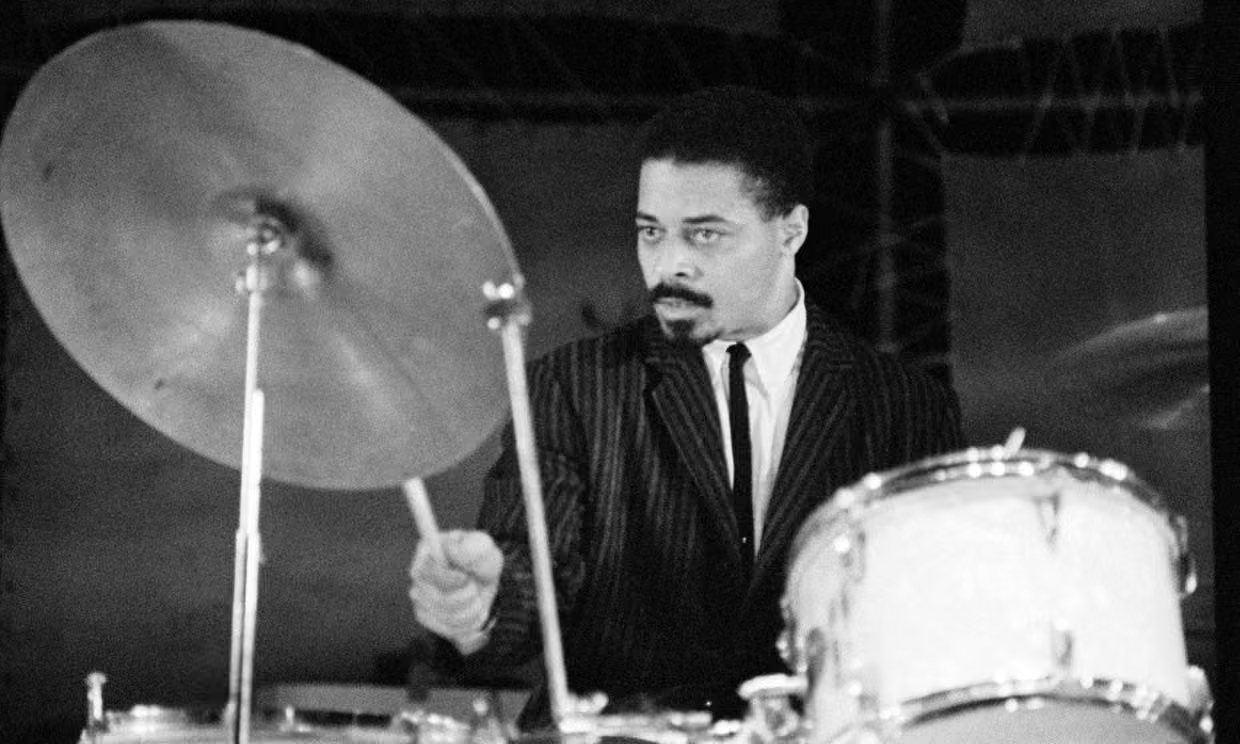
Photo: Jimmy Cobb. From 1958 to 1963 he drummed for Miles Davis *)
Click for the previous programme (no. 3) of this series *)
Click for the corresponding News item